|
My name is Theressa François. Have fun poking around! |
 |
My First Research Proposal
DECEMBER 3, 2017
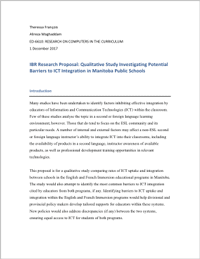
I decided early on in this course that the focus of my work would be the study of French-language ICT resource availability. My colleagues and I had a hunch that we were at a disadvantage compared to our English language colleagues since so few ICT are in French. What resources DO exist in French tend to be geared toward students in Québec or in France.
I had to do an extensive literature review for my research proposal. While there are a number of studies dealing with second language ICT integration, most of them were undertaken in ESL teaching environments. I did manage to find a few applicable studies, including one from Manitoba, and they were encouraging. Educators teaching languages other than English DO encounter difficulties finding appropriate ICT resources in their instructional languages. If I get to undertake this study, it may confirm that a lack of resources puts Francophone teachers in Manitoba at a disadvantage compared to their peers in the English system.
- Theressa
↻ BACK to TOP
Adventures with PowerPoint
NOVEMBER 13, 2017
I created this Powerpoint as part of another course regarding research in computers. It explains how difficult it can be for French Immersion and French Second Language teachers to find appropriate Francophone resources online.
This is the position paper I created including my preliminary observations regarding resouce availability for French-language educators: TFrancois_6610_Position_Paper.pdf
- Theressa
↻ BACK to TOP
Designing for Second and Foreign Language Learners
OCTOBER 16, 2017
While working on my literature review for another course, I found some practical and helpful articles and research papers to help guide the e-learning design process. What follows is an annotated list of my three favourite resources on approaches to designing tools for second and foreign language learners (not all of which ended up in my review.)
1. Ziegler, & Feucht, Nathan, Florian E. C. (2012). Technology and Second Language Learning: Developmental Recommendations for Early-Childhood Education. 151-179. Retreived from https://www-igi-global-com.qe2a-proxy.mun.ca/gateway/chapter/full-text-html/56378.
- This paper presents a framework, developed by the authors, for guiding teachers toward educational approaches and technologies that are most appropriate to a learner's cognitive developmental stage. The authors include plenty of practical advice for second and foreign language teachers, a strong endorsement of Computer-Based Concept Mapping and caveats surrounding the dangers of cognitive overload when practicing Content-Based Instruction.
2. Purushotma, R., Thorne, S. L., & Wheatley, J. (2009) 10 Key Principles for Designing Video Games for Foreign Language Learning [Internet]. Version 1. lingualgames. Retrieved from: https://lingualgames.wordpress.com/article/10-key-principles-for-designing-video-27mkxqba7b13d-2/.
- An excellent article that proposes 10 guiding principles of effective video game design for second language learners. The emphasis here is on task-based learning, but includes helpful advice such as the need to put “as much thought into the design of failure states as for succes states”. They also thoroughly discuss different gaming genres and their ideal target demographics.
3. Stepp-Greany, J. (2003). Designing Instructional Technology for Language Learning. Academic Exchange Quarterly, Winter 2003: Volume 7, Issue 4. Retrieved from http://www.rapidintellect.com/AEQweb/dec2595.htm.
- This paper was apparently influential as it has been cited in a number of subsequent studies. It's a very good, accessibly-written overview of learning theories with suggestions for real world applications using technology in second and foreign language classrooms. The author includes a checklist for designers looking to adopt constructivist approaches that encourage learner autonomy and empowerment. There's also a sample design that demonstrates the learner's progression through different stages of cognition.
- Theressa
↻ BACK to TOP
Looking for Educational Technology Journals?
SEPTEMBER 28, 2017
Wading through the panoply of online research regarding technology in the classroom (and online) can be daunting. I currently have access to Memorial University's excellent online library, but that likely won't be an option once I've graduated. A Google search turns up tons of research articles with the embedded search terms, but how can I know if the journals are legitimate and peer-reviewed?
EducationalTechnology.net to the rescue!

They call the list “partial” but I find it impressive nonetheless. I'm very pleased to see that they maintain the list (the last update was a month ago) and that they encourage users to report any broken links. The best feature, in my opinion, is that they vet the list and discard any predatory journals they identify.
Predatory journals (in case you weren't already aware) are those which invite researchers to submit their work while guaranteeing their studies will be published (for a hefty fee, of course). There is no peer review process whatsoever. Such “journals” prey on ignorant researchers or (worse) publish questionable studies by disreputable researchers who simply want to add a published study to their resumés.
Remember to check your sources folks!
- Theressa
↻ BACK to TOP